

There’s a reason you can look across a room and instantly know someone listens to metal, grew up in the golden era of hip-hop, or came of age in a punk basement. The question of why music rebellion translates to clothing isn’t just about aesthetics. It’s about identity made visible. Music has always been the engine of countercultural movements, but sound is invisible and temporary. Clothing is permanent, public, and impossible to unhear. The way rebellious music movements transform into wearable visual identities is one of the most fascinating mechanics in cultural history, and once you understand how it works, you’ll never look at a thrifted band tee the same way.
Table of Contents
- Key takeaways
- Why music rebellion translates to clothing: the identity script
- Punk’s safety pin and the boutique that built a rebellion
- How social media collapses the fashion rebellion timeline
- Why some rebellious motifs stick and others disappear
- Rebellious music fashion in contemporary wardrobes
- My take on the paradox of rebel fashion
- Wear the signal, not just the style
- FAQ
Key takeaways
| Point | Details |
|---|---|
| Music rebellion needs a visual form | Sound is fleeting, so fashion carries the ideology forward in daily, visible life. |
| Identity scripts drive fashion adoption | Subcultures create recognizable dress codes that fans use to signal belonging without saying a word. |
| Iconic symbols persist for a reason | Effective rebellious motifs are cheap, reproducible, and instantly readable in real-world social settings. |
| Social media accelerates the signal | Visual codes from rebellious music movements now travel globally within hours, not years. |
| Authenticity requires intentionality | Wearing rebellious fashion without understanding its roots risks cultural appropriation and diluting the message. |
Why music rebellion translates to clothing: the identity script
Every rebellious music movement comes with what you could call an identity script. This is the sociological term for the unspoken set of behaviors, values, and appearances that members of a subculture adopt to communicate who they are and what they reject. Music provides the emotional and ideological content of that script. Fashion translates it into a language anyone can read at a glance.
Think about how punk’s ripped aesthetics and hip-hop’s oversized silhouettes each map directly onto the values of their originating scenes. Punk said the establishment is broken, so wear broken clothes. Hip-hop’s early streetwear said we take up space, we are not invisible. These weren’t random aesthetic choices. They were deliberate visual arguments.
What makes this translation powerful is that it travels beyond the artists themselves. Fans adopt and adapt the visual identity because it lets them participate in the rebellion without being on a stage. As artist Iago Haussman noted, “the visual is almost as important” as the music itself, which tells you exactly how much ideological weight the wardrobe carries.
- Punk: Safety pins, torn fabrics, and stenciled slogans communicated deliberate rejection of polish and conformity.
- Hip-hop: Oversized hoodies, gold chains, and branded sportswear reclaimed visibility and economic aspiration in one look.
- Metal: Black everything, band graphics, and studded leather created a uniform for those who felt outside the mainstream social contract.
- Grunge: Flannel, thrift-store layers, and deliberately unkempt style rejected the glossy excess of 1980s pop culture.
Pro Tip: When you’re building a look inspired by a music movement, start by understanding the ideology first. The clothing will make more sense, and you’ll avoid wearing the symbols without the substance behind them.
Punk’s safety pin and the boutique that built a rebellion
No example in music fashion history is more instructive than punk. The story of how it developed its visual identity is almost a perfect laboratory for understanding how music rebellion becomes clothing.
The safety pin as fashion weapon emerged in the mid-1970s as punk bands like the Sex Pistols turned an ordinary hardware item into a symbol of defiance. Wearing a safety pin visibly on your body or clothing was a specific social act. It said: I am holding myself together with whatever I can find. I don’t need your luxury. It also deliberately unsettled the people who saw it, which was exactly the point.
Malcolm McLaren and Vivienne Westwood built the physical infrastructure for this visual rebellion through their London boutique, known at one point as “Sex.” Their boutique shaped punk’s visual vocabulary by supplying slogans, collage aesthetics, torn garments, and provocative graphics that matched the music’s confrontational energy perfectly. It was the first time a boutique functioned as a subcultural hub where music and fashion co-created an ideology rather than one simply borrowing from the other.
Here’s how punk’s visual identity developed in practice:
- Appropriation of mundane objects. Safety pins, bin liners, and charity-shop finds were recontextualized as intentional style choices, not poverty.
- DIY construction. Tearing, writing on, and customizing clothing signaled that the wearer rejected the need for professional, commercially produced fashion.
- Anti-polish as manifesto. Punk’s distressed aesthetics communicated a visible refusal of dominant fashion norms and the societal values they represented.
- Deliberate provocation. The styling was designed to unsettle, not to please, which made it inherently political even before anyone read the slogans.
“Punk clothes were not just fashion. They were arguments. Every tear, pin, and slogan was a sentence in a political essay that anyone could read standing in line at a bus stop.”
The evolution didn’t stop there. Punk motifs moved from underground subculture to mainstream fashion decades later, appearing on runways and in retail chains. That migration is itself part of the story because it shows how powerful the visual language was. It was legible enough to be universally recognized even when stripped of its original context.
How social media collapses the fashion rebellion timeline
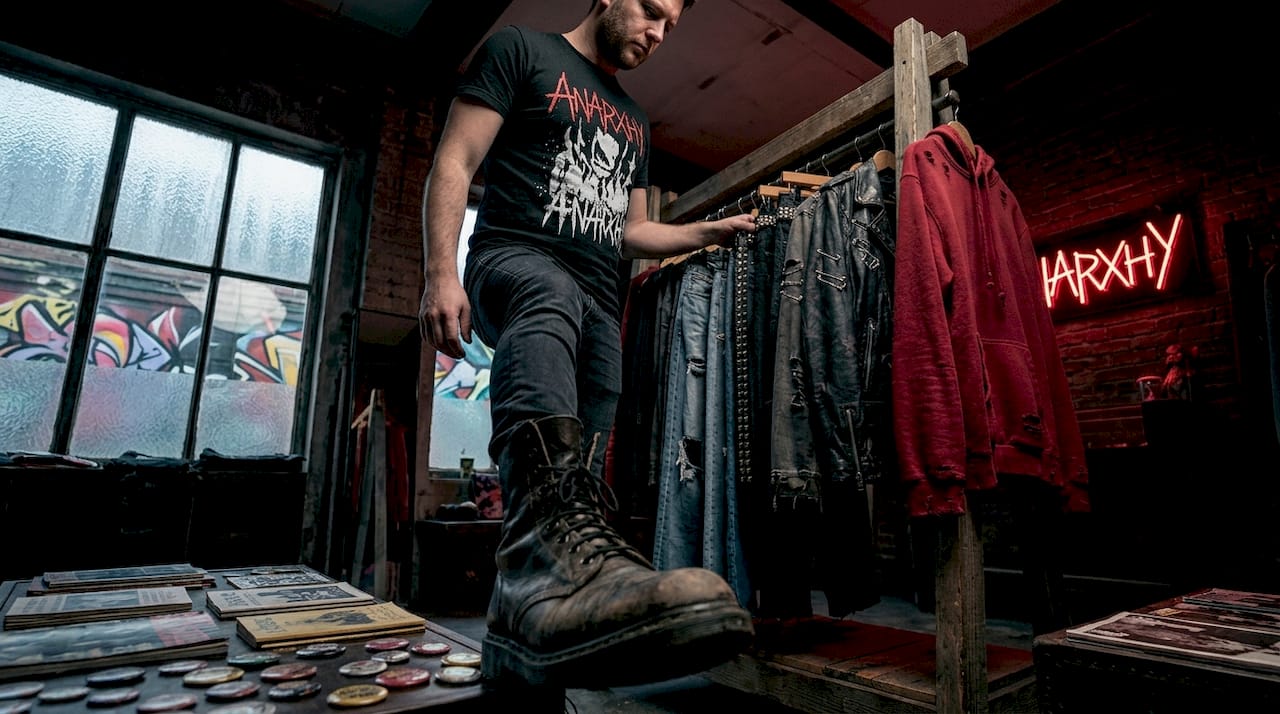
Before Instagram and TikTok, a rebellious music scene’s fashion vocabulary might take years to travel from a specific city to global recognition. Today, visual motifs spread within hours of hitting a stage or a protest. That compression changes everything about how clothing inspired by rebellion functions.
A musician’s outfit at a major festival becomes a reference point almost instantly. Fans screenshot, repost, and riff on the look before the encore is finished. Independent brands with fast production turnaround can have versions available within weeks. What once required years of organic subcultural transmission now happens in a single news cycle.
This has real consequences worth understanding:
- Acceleration of identity adoption. People can align with a music movement’s visual codes faster than ever, building community across geographic distance.
- Risk of flattening. When a rebellious visual code spreads too fast, it loses the specific cultural context that gave it meaning. The symbol survives but the substance can hollow out.
- New forms of authenticity. Social platforms also allow niche scenes to maintain tight visual identities precisely because their codes can travel to the people who genuinely belong while being too specific for casual adoption.
The impact on fashion design and marketing has been dramatic. Brands that understand music culture and fashion now design with social legibility as a primary consideration. Not just “does this look good in person” but “does this communicate instantly in a 1.2-second scroll.”
Why some rebellious motifs stick and others disappear
Not every rebellious fashion moment becomes a lasting symbol. The ones that endure share a specific set of characteristics that go deeper than aesthetic preference. This is where semiotics, the study of signs and symbols, becomes genuinely useful for understanding the impact of music on fashion.
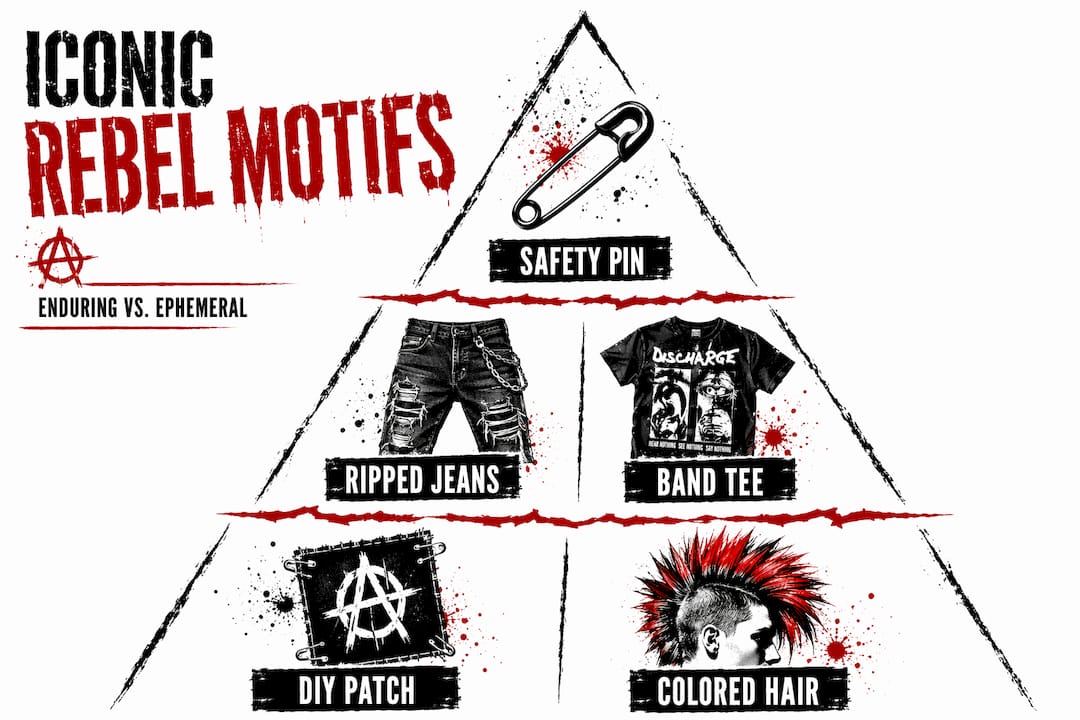
Rebellious clothing that lasts tends to be cheap to produce or acquire, easily reproducible by individuals, visually stable across different contexts, and distinctive enough for fast recognition. Safety pins check every box. So do band tees, oversized hoodies, and ripped denim.
Here’s a comparison of two rebellious motifs and why one outlasted the other:
| Motif | Longevity | Why it worked or didn’t |
|---|---|---|
| Safety pin (punk) | Decades and still recognized | Cheap, universal, easy to reproduce, loaded with meaning |
| Specific neon rave gear (early rave scene) | Faded quickly outside context | Required specific settings to read correctly, hard to wear daily |
Clothing also functions as what researchers call boundary control. Insiders use recognizable hardware, color rules, and DIY construction to signal belonging and implicitly mark who is outside the group. This dual function, welcoming to insiders and legible as “other” to outsiders, is what gives rebellious dress its social power.
There’s a deeper reason why fashion preserves rebellion after a scene’s peak moment. Music is transient. A gig ends, an album cycle closes, a scene disperses. Clothing keeps the emotional and ideological stance alive in everyday life, outside the concert venue, on the street, in the classroom, at the workplace. Wearing the look is a daily act of continuing the argument.
Pro Tip: Subcultures often repurpose found and vintage materials, so thrift stores are the most authentic starting point for building a music-inspired rebellious wardrobe. The DIY process is part of the meaning, not just the end result.
Rebellious music fashion in contemporary wardrobes
Understanding how rebellious music influences dress isn’t just historical. It’s happening right now, in ways you can recognize and engage with intentionally.
Contemporary designers and statement clothing rooted in music culture continue to translate rebellious motifs into wearable pieces that carry real cultural weight. The key is knowing what separates authentic engagement from surface-level borrowing.
- Look for design intent. Brands that genuinely engage with music rebellion as ideology, rather than aesthetic trend, tend to show it in their material choices, their manifesto language, and their community relationships.
- Prioritize limited production. The scarcity logic of rebellious fashion, rooted in DIY and underground economics, still matters. Mass-produced rebellion is a contradiction in terms.
- Mix eras intentionally. Modern rebellious wardrobes often layer references: a vintage band tee under a contemporary distressed hoodie signals fluency in the cultural language, not just familiarity with the surface.
- Understand before you adopt. Wearing a Dead Kennedys shirt without knowing the band, or dressing in indigenous-influenced protest fashion without the politics, crosses into appropriation. The clothing carries the ideology whether you know it or not.
The most interesting thing happening in music-influenced fashion right now is the merging of dystopian aesthetics with streetwear construction. Scenes that reject both mainstream pop culture and traditional punk nostalgia are creating visual vocabularies rooted in digital alienation, environmental anxiety, and political disillusionment. That’s a new chapter of the same story punk started in 1976.
My take on the paradox of rebel fashion
I’ve spent years watching the cycle play out: a music scene creates a visual language from necessity and conviction, the fashion industry discovers it, the boutiques package it, the chains dilute it, and then a new scene starts the whole process again with something the mainstream hasn’t gotten to yet.
What I’ve learned is that the paradox of rebellious fashion becoming a commercial product doesn’t actually kill the original impulse. It displaces it. When punk ended up on runway collections, real punks had already moved on to creating new visual signals. The mainstream always arrives late to the party and by then the people who built the thing have already gone somewhere else.
What I find genuinely interesting is the DIY dimension. Every time the industry tries to replicate the look of rebellion by spending money, it misses the point. Safety pins cost nothing. Thrift store finds cost almost nothing. The most powerful rebellious wardrobes I’ve ever seen were built on a budget that a mainstream brand couldn’t conceptualize, because the creativity was the rebellion, not the product.
The fashion keeps the music’s argument alive in a way that streaming never will. You can listen to a song passively. You can’t wear a look passively. Every time you put it on, you’re making a choice about who you are and what you reject. That’s why this translation keeps happening, and why it always will.
— Johnathan
Wear the signal, not just the style
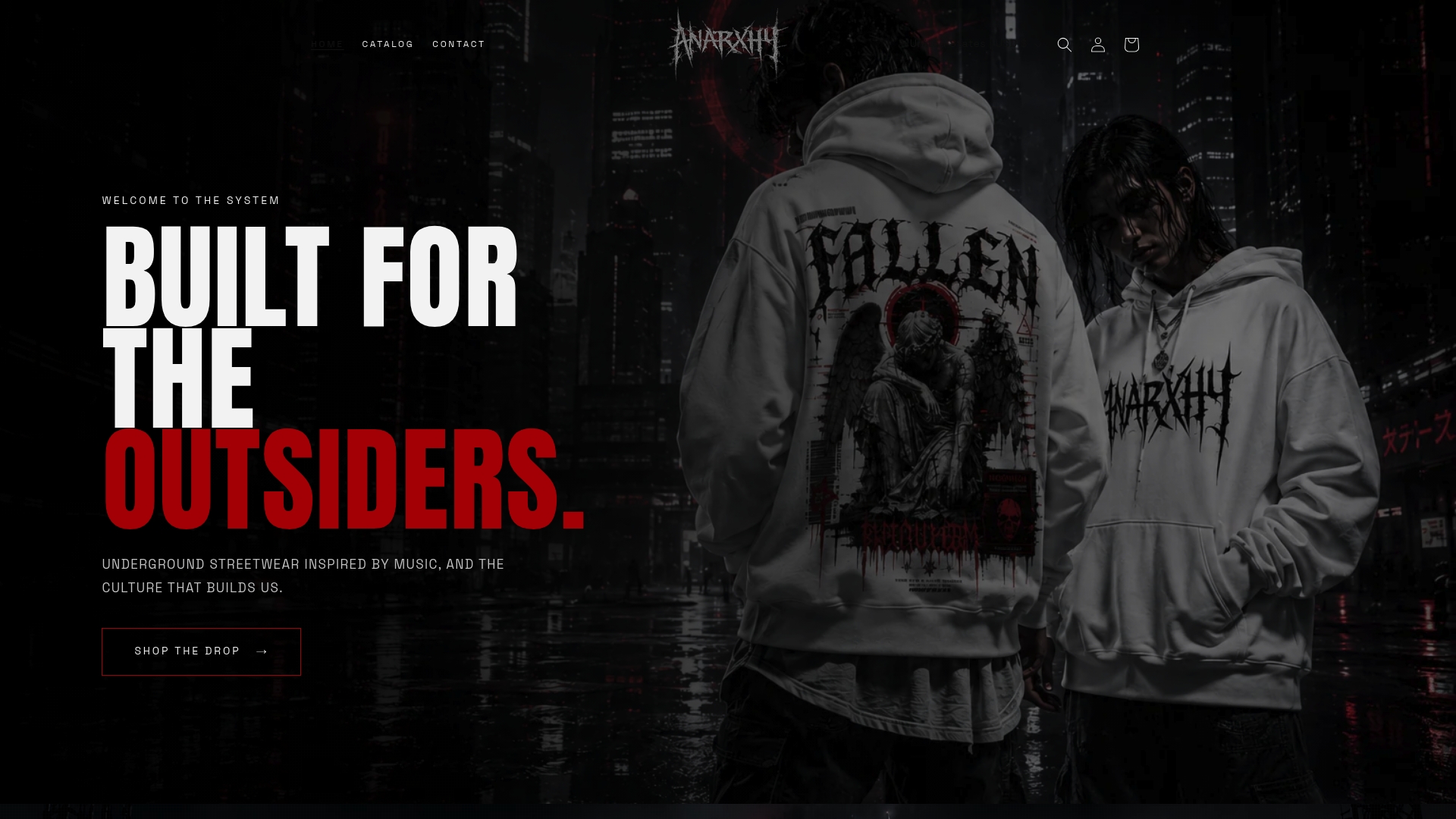
If this is the kind of fashion thinking you’re drawn to, Anarxhy builds exactly what this article describes: clothing where the ideology comes first and the aesthetic follows. Every piece in the Signal Lost collection is built around the outsider ethos, drawing directly from the visual languages of music rebellion rather than borrowing surface-level aesthetics. The DIGITAL DECAY hoodie and the SYSTEM ERROR hoodie both carry that same boundary-control function that the best rebellious fashion always has: instantly legible to people who get it, and irrelevant to everyone else. Made with eco-friendly materials, limited drops, no mass production. That’s not a marketing claim. It’s the only way to make this kind of clothing without betraying what it stands for.
FAQ
Why does rebellious music always create its own fashion?
Music rebellion needs a visible form to exist outside the concert or record. Clothing carries the ideology into everyday life, making the stance permanent and public rather than temporary and private.
What makes a rebellious fashion symbol last for decades?
The most enduring symbols, like punk’s safety pin, are cheap, easy to reproduce, visually stable across contexts, and carry enough meaning to function as instant social signals in real-world settings.
How does social media change music-inspired fashion today?
Visual codes from rebellious music movements now spread globally within hours, accelerating adoption but also increasing the risk that symbols lose their cultural substance before their context is understood.
Is it possible to wear rebellious music fashion without appropriating it?
Yes, but it requires understanding the ideology behind the clothing before adopting the aesthetic. Wearing the look without the knowledge flattens the symbol and disconnects it from the community that created it.
What is the relationship between DIY aesthetics and music rebellion in fashion?
DIY construction is not just a style choice. It’s a direct expression of the anti-commercial values at the core of most rebellious music movements, which is why subcultures repurpose found materials rather than buying purpose-built fashion.