

The anti-fashion movement is defined as the deliberate rejection of mainstream, cyclical fashion in favor of personal identity, longevity, and ideological resistance. Unlike trend-driven consumption, anti-fashion prioritizes permanence over seasonal turnover, meaning over status, and authenticity over brand allegiance. Scholars like Georg Simmel and Ted Polhemus framed this opposition sociologically: Simmel identified fashion as a tool of social distinction and assimilation, while Polhemus documented how subcultures use dress to signal cultural dissent. Anti-fashion is not simply dressing badly or ignoring clothes. It is a conscious rejection of the fashion industry’s commercial logic, choosing garments that last decades over pieces designed for obsolescence.
What is the anti-fashion movement? Origins and key milestones
Anti-fashion did not emerge from a single moment. It developed through distinct historical waves, each driven by cultural and political pressure.
The 1950s: rock-and-roll rebellion
Rock-and-roll culture in the 1950s was the first mass challenge to postwar fashion conformity. Young men in leather jackets and women in tight skirts defied the era’s prescribed gender norms. This was not accidental. Clothing became a signal of generational refusal, a way to say the mainstream did not speak for you.
The 1970s: punk’s total rejection
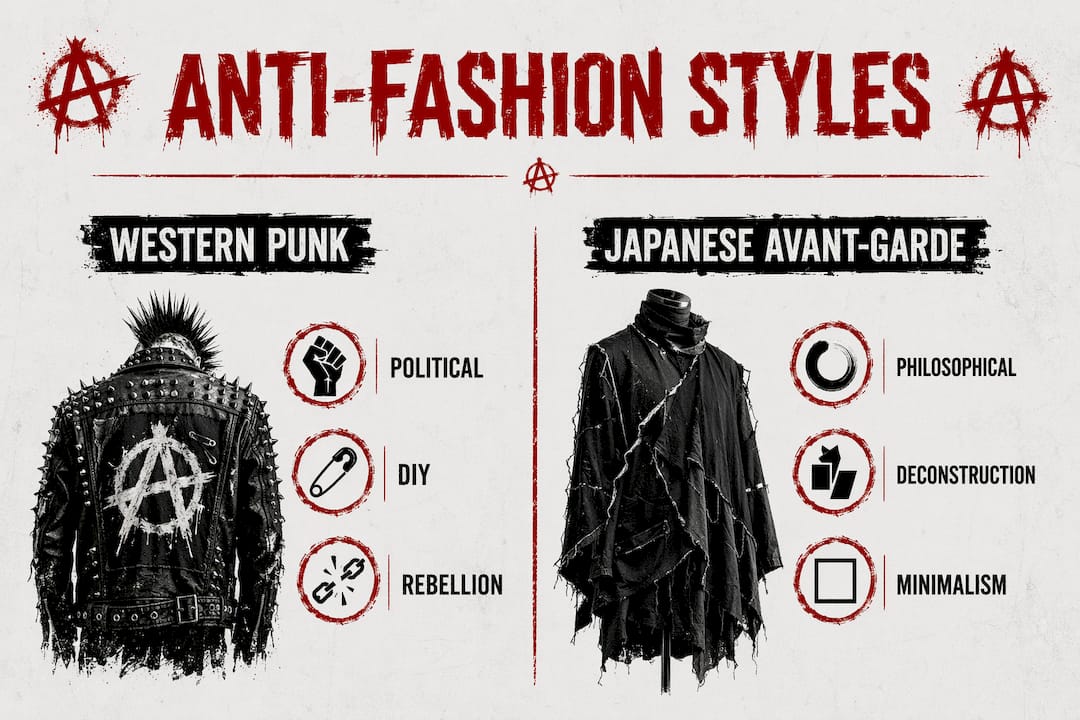
Punk took that refusal further than any movement before it. Malcolm McLaren and Vivienne Westwood used clothing as revolutionary action, aligning DIY aesthetics with avant-garde political movements that rejected consumerism outright. Torn fabric, safety pins, and hand-painted slogans were not fashion choices. They were confrontations. Punk’s anti-fashion style proved that dress could function as direct political speech.
Pro Tip: If you want to understand punk’s visual logic, study Westwood’s early work from the 1970s. The construction choices were deliberate provocations, not accidents of poverty.
The 1980s: Japanese avant-garde deconstruction
The 1980s brought the most intellectually sophisticated wave. Rei Kawakubo and Yohji Yamamoto introduced oversized, asymmetrical silhouettes that shocked Paris fashion week audiences. These designers did not reject fashion carelessly. They rebuilt it from a different philosophical foundation, one rooted in Japanese aesthetics and a refusal of Western beauty standards. Kawakubo’s work for Comme des Garçons transformed anti-fashion into high-concept luxury, proving that rejecting convention could itself become a form of mastery.
Gabrielle Chanel deserves mention here too. Decades earlier, she stripped away the corset and the excess of Edwardian dress, replacing ornamentation with function. That act of subtraction was anti-fashion in its purest form: removing what the industry insisted was necessary.
How does anti-fashion challenge mainstream fashion’s psychology?
Mainstream fashion runs on a specific psychological engine. Georg Simmel’s theory explains it clearly: fashion serves two opposing drives simultaneously, the desire to belong and the desire to stand apart. Brands exploit both drives by creating trends that feel exclusive but are designed for mass adoption. Anti-fashion disrupts this by valuing permanence and stability over the cycle of distinction and assimilation.
“Anti-fashion is not the absence of style. It is the refusal to let the market define what style means. Permanence, resistance, and ideological meaning replace the seasonal churn that keeps consumers spending and insecure.”
The commercial critique runs deeper than aesthetics. Status consumption, the purchase of logos and branded goods to signal social position, is the engine that keeps the fashion industry profitable. Anti-fashion rejects this engine entirely. Practitioners build wardrobes around utility and meaning rather than visibility and recognition.
Three principles define anti-fashion’s philosophical foundation:
- Atemporality. Garments are chosen or designed to remain relevant for decades, not seasons. Designers avoid seasonal releases and aim for conceptual and physical durability instead.
- Intentional imperfection. Exposed seams, raw edges, and unfinished hems challenge polished mass production norms. This demystifies garment construction and frames the making process as part of the meaning.
- Ideological signification. Every garment carries a position. Anti-fashion dress communicates refusal, identity, and cultural allegiance in ways that logo-driven fashion cannot replicate.
What are the most recognized anti-fashion examples and styles?
Anti-fashion expresses itself across a wide range of movements and design philosophies. Understanding the differences between them clarifies what the philosophy actually demands.
| Style or movement | Core principle | Key expression |
|---|---|---|
| Punk | Political confrontation | DIY construction, torn fabric, slogans |
| Japanese avant-garde | Wabi-sabi and deconstruction | Asymmetry, raw finishes, oversized forms |
| Grunge | Indifference to polish | Thrift-sourced layering, deliberate dishevelment |
| Victorian rational dress | Functional liberation | Removal of corsets, practical silhouettes |
| Ethical upcycling | Environmental resistance | Repurposed materials, local sourcing |
Japanese designers brought a specific cultural philosophy to anti-fashion that Western punk did not. Wabi-sabi, the Japanese aesthetic of finding beauty in imperfection and transience, gave Kawakubo and Yamamoto a framework for creating garments that questioned decoration itself. A frayed hem was not a flaw. It was an argument. This approach to avant-garde streetwear aesthetics continues to influence designers working outside the mainstream calendar today.
Grunge in the early 1990s brought anti-fashion into American popular culture through bands like Nirvana. Flannel shirts, worn-out jeans, and thrift-store finds were not poverty aesthetics. They were a refusal to perform aspiration. The look said: I will not dress to impress the system I reject.
Pro Tip: The difference between genuine anti-fashion and superficial thrift-store minimalism is intention. Buying cheap clothes without a philosophical position is just frugality. Anti-fashion requires knowing what you are refusing and why.
Confusing anti-fashion with minimalism or thrift trends misses the point entirely. The core philosophy demands deliberate resistance and ideological meaning, not just a smaller wardrobe or a preference for neutral colors.
How does anti-fashion connect to sustainability and identity in 2026?
Anti-fashion’s contemporary relevance is strongest in two areas: environmental sustainability and personal identity. Both connect directly to the movement’s original philosophical commitments.
The sustainability argument is concrete. Anti-fashion practitioners prioritize slow production, local sourcing, and upcycling to reduce the carbon footprint that fast fashion generates at scale. A small, quality wardrobe built around pieces that remain relevant for decades produces far less waste than a closet refreshed every season. The upcycled streetwear approach takes this further by transforming existing materials into new garments, cutting demand for virgin textile production entirely.
The identity argument is equally direct. Anti-fashion functions as a decolonial practice, shifting power away from Eurocentric beauty standards toward personal and indigenous expressions of dress. Sociologist Shakti Shukla identifies this as anti-fashion’s most politically significant dimension. When people dress in culturally specific textiles and silhouettes rather than globally uniform brand aesthetics, they reclaim authorship over their own appearance.
Key ways anti-fashion practitioners engage with identity and sustainability in 2026:
- Refusing logo-driven purchases that signal status rather than meaning
- Choosing regionally specific textiles over globally manufactured fast fashion
- Building wardrobes around fashion and personal identity rather than seasonal trends
- Supporting designers who work outside the fashion calendar
- Using clothing to communicate cultural allegiance and political position
The connection between anti-fashion and subcultures remains strong. Communities organized around music, political dissent, and alternative culture continue to use dress as a primary language of belonging. This is not nostalgia for punk or grunge. It is the same impulse applied to 2026’s specific cultural pressures, including algorithmic trend cycles, influencer-driven consumption, and the homogenization of global street style.
Key Takeaways
The anti-fashion movement is a deliberate, philosophy-driven rejection of commercial fashion cycles, prioritizing permanence, identity, and sustainability over seasonal trends and status consumption.
| Point | Details |
|---|---|
| Anti-fashion definition | A conscious refusal of trend-driven fashion in favor of longevity, identity, and ideological meaning. |
| Historical roots | Punk, rock-and-roll rebellion, and Japanese avant-garde each advanced the movement through distinct cultural moments. |
| Philosophical core | Atemporality, intentional imperfection, and ideological signification define genuine anti-fashion practice. |
| Sustainability link | Slow production, upcycling, and quality-focused wardrobes reduce fashion’s environmental impact directly. |
| Identity and decolonization | Anti-fashion reclaims dress from Eurocentric standards, centering personal and cultural authenticity. |
Why anti-fashion is harder to practice than it looks
Anti-fashion gets co-opted constantly. That is the uncomfortable truth. The moment a subculture’s visual language becomes recognizable, the mainstream fashion industry absorbs it, strips out the ideology, and sells it back as an aesthetic. Punk became a runway theme. Grunge became a Gap campaign. Wabi-sabi became a luxury marketing term. This cycle does not invalidate anti-fashion. It just means that genuine practitioners have to work harder to maintain the philosophy beneath the surface.
What I have found is that most people who call themselves anti-fashion are actually just anti-trend. They prefer older clothes, neutral palettes, or thrift-store sourcing. That is a valid lifestyle choice, but it is not anti-fashion in the philosophical sense. True anti-fashion requires knowing what you are resisting and building a consistent position around it. The garments are evidence of the position, not the position itself.
The most honest engagement with anti-fashion I have seen comes from people who treat how fashion communicates rebellion as a serious question rather than an aesthetic preference. They think about construction, sourcing, cultural context, and longevity before they buy anything. That level of deliberateness is rare. It is also exactly what the movement demands.
— Johnathan
Anarxhy and the anti-fashion ethos in practice
Anarxhy builds collections for people who already understand what anti-fashion requires. The brand’s Signal Lost series applies dystopian aesthetics and raw design to garments made from eco-friendly materials, combining ideological position with environmental accountability. That combination is not common in streetwear.

The FALLEN//001 hoodie is a direct expression of this philosophy: unisex construction, sustainable fabric, and a design built for longevity rather than seasonal relevance. Anarxhy releases in limited drops, which keeps production intentional and avoids the overstock waste that defines fast fashion. If you are building a wardrobe around meaning rather than trend cycles, Anarxhy’s catalog is worth your attention.
FAQ
What is the anti-fashion movement in simple terms?
The anti-fashion movement is a deliberate rejection of mainstream, trend-driven fashion in favor of personal identity, sustainability, and garments built to last. It opposes the commercial logic of seasonal cycles and status consumption.
Who are the key figures in anti-fashion history?
Rei Kawakubo, Yohji Yamamoto, Vivienne Westwood, and Malcolm McLaren are among the most influential figures. Gabrielle Chanel’s early work also qualifies as foundational anti-fashion practice through its rejection of Edwardian excess.
How does anti-fashion differ from minimalism?
Minimalism is an aesthetic preference for simplicity. Anti-fashion is a philosophical position that requires deliberate resistance to commercial fashion systems. A minimalist wardrobe without ideological intent does not qualify as anti-fashion.
Is anti-fashion the same as sustainable fashion?
Anti-fashion and sustainable fashion overlap significantly but are not identical. Anti-fashion’s sustainability comes from its rejection of trend cycles and disposable consumption. Sustainable fashion can still operate within trend systems while using ethical materials.
How does anti-fashion connect to cultural identity?
Anti-fashion functions as a decolonial practice by pushing back against Eurocentric beauty standards and global consumer uniformity. Dressing in culturally specific textiles and silhouettes reclaims authorship over personal appearance from the global fashion industry.